
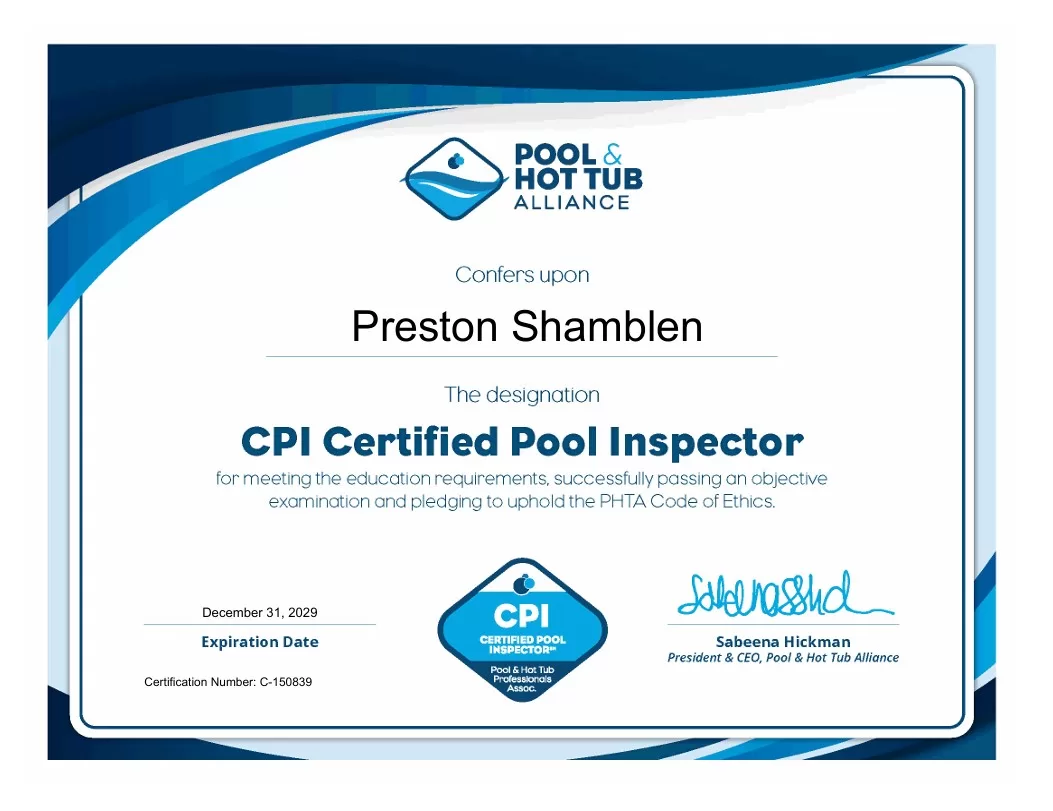
If you own a pool in San Angelo, you already know the truth: pools don’t usually “explode” into problems overnight — they quietly drift into them. A loose fitting here. A failing gasket there. A drain cover that isn’t what it should be. A pump that’s working… but not working right.
That’s exactly why we added something new at Concho Valley Pool: professional pool inspections backed by real certifications — not just “I’ve cleaned pools before.”
We’re a family-owned pool cleaning and maintenance business based right here in San Angelo, and we’ve been doing this for over 13 years. We’re not a franchise. We’re not a chain. We’re the people who show up, do it right, and treat your backyard like it matters — because it does.
Our Certifications (and why they matter in Texas)
Most pool guys in Texas can clean a pool without ever earning a formal certification. That’s the reality.
But we decided a long time ago that “good enough” isn’t good enough when you’re dealing with water safety, equipment, electricity, suction systems, and families swimming in it.
Certified Pool Inspector (CPI)

A Certified Pool Inspector (CPI) is trained to evaluate a pool like an inspector — not just a cleaner.
That means looking for the stuff homeowners don’t always notice until it becomes expensive (or dangerous), including:
- equipment and circulation red flags
- safety hazards around the pool and deck
- suction / drain safety issues
- obvious leak indicators
- installation and condition issues that should be documented and fixed
Certified Pool Operator (CPO®)
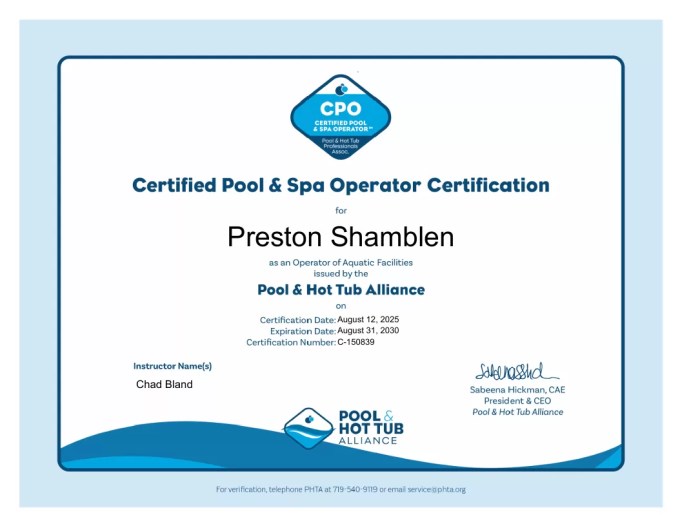
A Certified Pool Operator (CPO®) is focused on water quality, safety, and compliance — especially for commercial pools like apartments, hotels, and HOAs.
Even for homeowners, the CPO training matters because it means we understand:
- how chemistry interacts with real-world conditions (sun, heat, rain, bather load)
- what “safe water” actually means (not just “it looks blue”)
- how to prevent recurring algae / cloudy water cycles
- how to spot problems in circulation and filtration that cause never-ending chemical demand
Bottom line: You’re not just hiring someone who dumps chemicals and leaves. You’re hiring someone who’s trained to evaluate the whole system.
And yeah — I spend my free time training physically and mentally for this job. Pools are hard work, and doing it right takes more than “show up with a net.”
When should a homeowner get a pool inspection?
If any of these sound like you, a pool inspection is a smart move:
- You just bought a house with a pool (and want to know what you really inherited)
- Your pool is always fighting algae or keeps turning cloudy
- You suspect a leak or unexplained water loss
- The pump is noisy, the filter pressure seems off, or the system is “running” but performance is weak
- You’ve got kids swimming and want to know the safety side is solid
- You want a second set of eyes on your setup before summer
- You’ve been DIY’ing or using a service and you just want a clear, honest assessment
A lot of people wait until something breaks. Inspections are how you catch issues before you’re forced into expensive repairs.
What we check during a pool inspection
Every pool is different — but for most San Angelo backyard pools, the inspection focuses on the biggest risk and cost areas:
Equipment & circulation
- pump operation and obvious wear/leaks
- filter condition, pressure red flags, and general performance
- valves, fittings, and visible plumbing concerns
- signs of air leaks, flow restrictions, or poor circulation
Water clarity & chemistry snapshot
- basic on-site testing and clarity check
- signs that filtration or circulation is causing chemical imbalance
- practical recommendations (not “buy 12 different bottles”)
Safety & hazard items
- decking trip hazards, loose handrails/ladders, unstable hardware
- basic barrier / gate safety concerns (where applicable)
- suction/drain safety red flags that should never be ignored
Leak indicators (when relevant)
- visible equipment pad leaks
- abnormal water loss patterns (as best as can be assessed without extended monitoring)
- recommendations for next steps if a leak is suspected
We’re not here to scare you — we’re here to tell you the truth, clearly.
What you get after the inspection
You’ll get a straightforward, homeowner-friendly summary of what we found, including:
- what looks good
- what needs attention soon
- what should be fixed ASAP
- photos/notes when helpful
- optional estimate if you want us to handle repairs
No pressure, no drama. Just a real assessment.
Why San Angelo pools need special attention
San Angelo isn’t “easy mode” for pools.
Between heat, wind/dust, and storms/rain, your water and equipment take a beating:
- filters clog faster
- chemistry drifts quicker
- algae can bloom fast after rain/runoff
- small leaks turn into big water bills when it’s 100° outside
A proper inspection helps you get ahead of that.
Schedule a pool inspection in San Angelo
If you want a pool inspection from a certified pro — not just a random “pool guy” — we’ve got you.
Text a photo of your pool to 469-585-4093 to get a quote or check availability.
Or visit: ConchoValleyPool.com
We serve San Angelo and surrounding areas including Christoval, Grape Creek, and Wall.
Quick FAQ
Do I need an inspection if my pool looks fine?
A lot of expensive problems start while the pool still looks “fine.” Inspections are about preventing surprises.
Is this only for home buyers?
No — inspections are great for existing homeowners who want peace of mind or are fighting recurring issues.
Can you fix what you find?
Yes — if you want us to. If not, you still get the information you need to make the right call.